
Retrofuture Commander
A Subsection of [Bracket 2]

[The Bracket System]
One year ago on this day, I made an article hyping up the RC’s commander philosophy document… only 18 days later the RC received a wave of vitriol that caused them to hand over our beloved format to Wizards of the Cost (blessed be thy name). Whew! Unfortunate timing! I have posted some thoughts here and there on my BlueSky, but I’ve been hesitant to release an article detailing my full opinions as I didn’t want to get involved with the hype or drama. Besides, I’m more of a person who makes esoteric shower-thought articles that string random unrelated concepts together under the guise of trading cards. A day may come when I write an article in more depth about my thoughts, but it is not this day!
My short summation: I am glad Mana Crypt is banned (the banlist should serve gameplay, not financial value). It sucks that our corporate overloads rule or format instead of an independent third party. The [bracket system] itself has been really cool and based for people who actually use it. So I remain cautiously optimistic about what the future holds for our format.
[Bracket 2]
If you’ve kept up with me, or the few articles I have written (I post write I want to, deal with it - maybe you enjoy that, though, since it means I don’t put weekly slop in your inbox), you may know that my comfortable home is [bracket 2]. Overall we played at [bracket 2] already, but having brackets helped us simplify our description while still getting the vibe across.
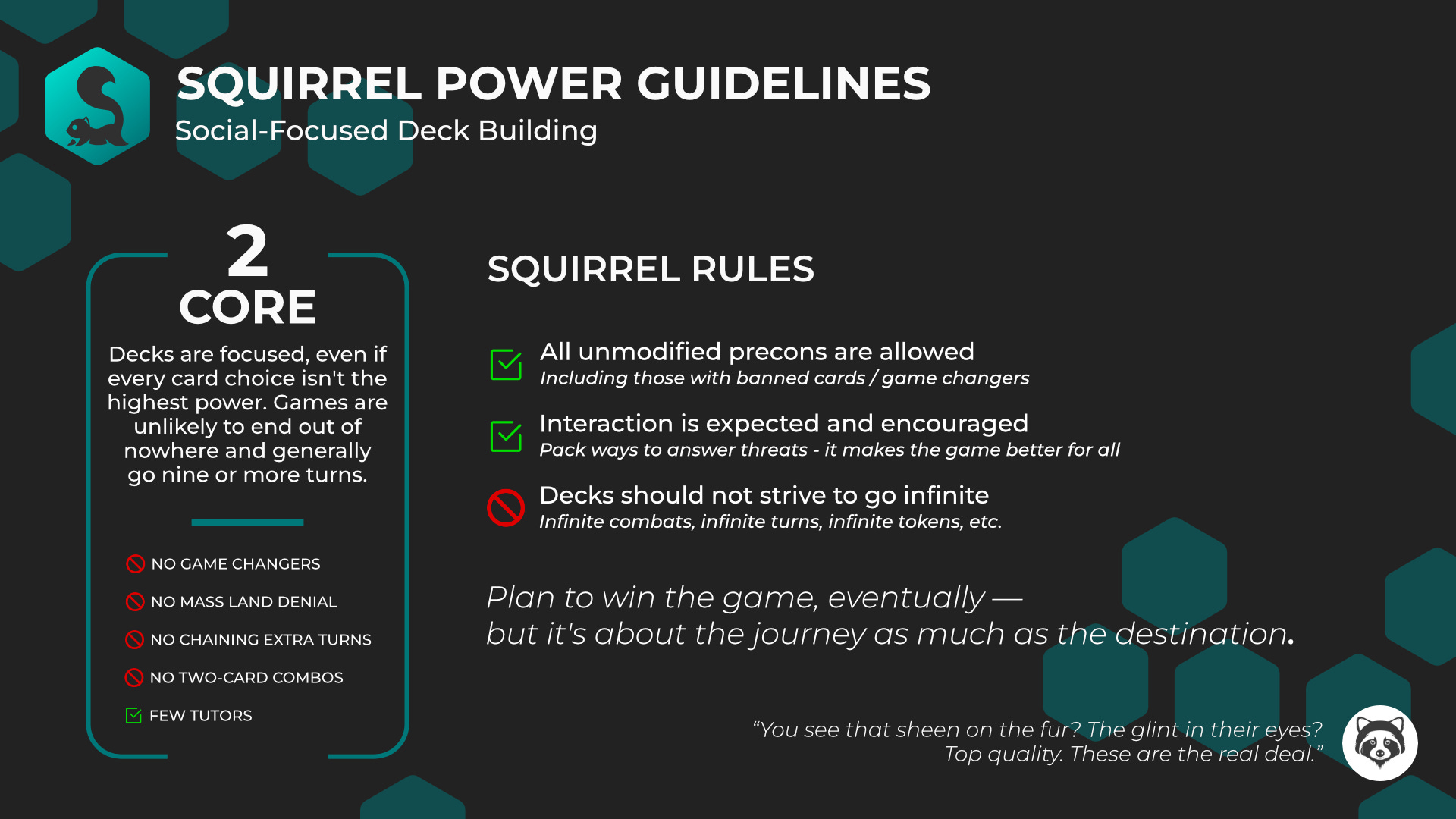
Outside of the Squirrel Nest, I’ve also hit up some games with randoms on Spelltable… and the “wild west” of the internet is where the bracket system really shines in helping set expectations for certain types of gameplay. Honestly [bracket 2] is great! It ends up feeling way more “casual” than a lot of games that I found before, and it’s a safe space where you can expect to not see certain cards (notably game changers, but often even more stuff is excluded on vibes).
[The Players]
So, to finally get to the point of the article (other than bragging about good games and healthy playgroup): I’ve found that, among those who call [bracket 2] their home, they broadly fall into one of two categories.
Beginner
/noun/
: one that begins something
especially : an inexperienced person
(definition provided by mirriam-webster)
The first group of denizens of [bracket 2] are those who are just picking up the format. They’re trying to get involved and learn all the ropes. This group of people is vital to the growth of the format, but I think everyone knows that they play here, so let’s move on to the lesser known group.
RetroFuture
/adjective/
Retrofuturism is a movement in the creative arts that visualizes the future through the lens of a past era's technological and cultural understanding.
(definition provided by aesthetics fandom wiki)
This group of inhabitants is equally important as the first group, if for no other reason than likely being the first set of experienced players that the aforementioned beginners will run into when playing. These are players who have played at a variety of power levels, but decided that a version of the game that pulls a lot more punches is often more fun to play. Importantly, these players are often old souls who have played EDH for a long time, and are at least somewhat chasing the nostalgic feeling of playing commander as it was between 2006-2011 (or the feeling of anemoia if they weren’t playing at that time). These players are chasing the vibes and feelings of playing Pre-EDH, but they want to still play new cards. This is the group I’m here to talk about today… and this is the group that I fall into.
[What is Retrofuture]
To start to get into what I’m getting at, let’s describe retrofuture aesthetics slightly more. Put simply... retrofuture is the answer to the question: if you were to ask someone in the past what our current era would look like, what would they draw?
Answering this question is simple, because people in the past DID draw depictions of the future. Often those depictions were not isolated, and they formed solid and widespread canons for what the future might look like:
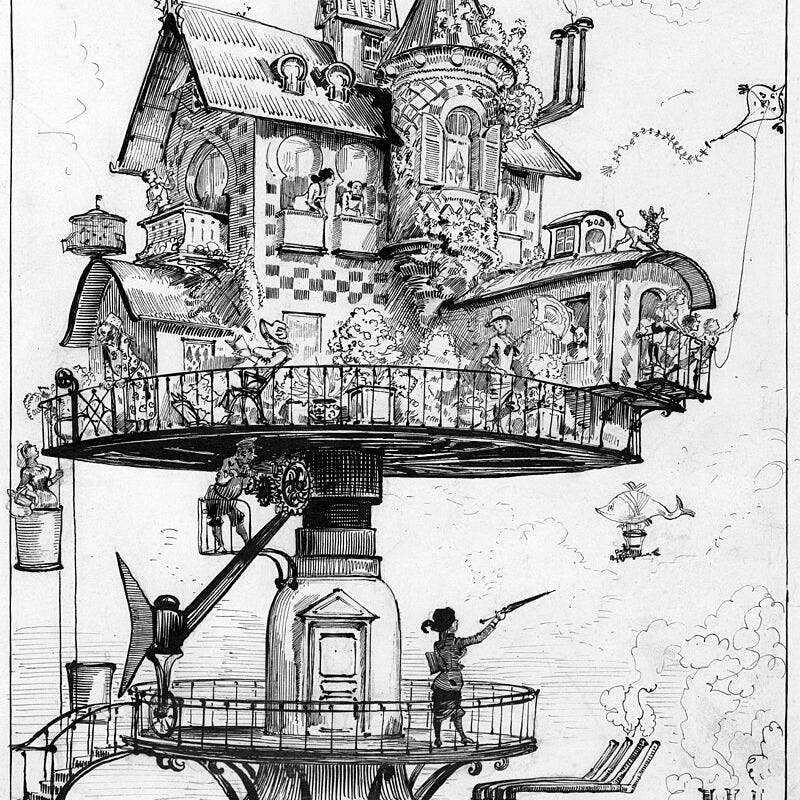
In the above image, 19th century thinker Albert Robida has drawn a depiction of what 20th century life might look like. Many similar creators in the 19th century adopted and contributed to this vision of the future that would never come to be. Nowadays we look back at and celebrate the aesthetic of this canon by using it in modern media, and refer to it as “steampunk.”
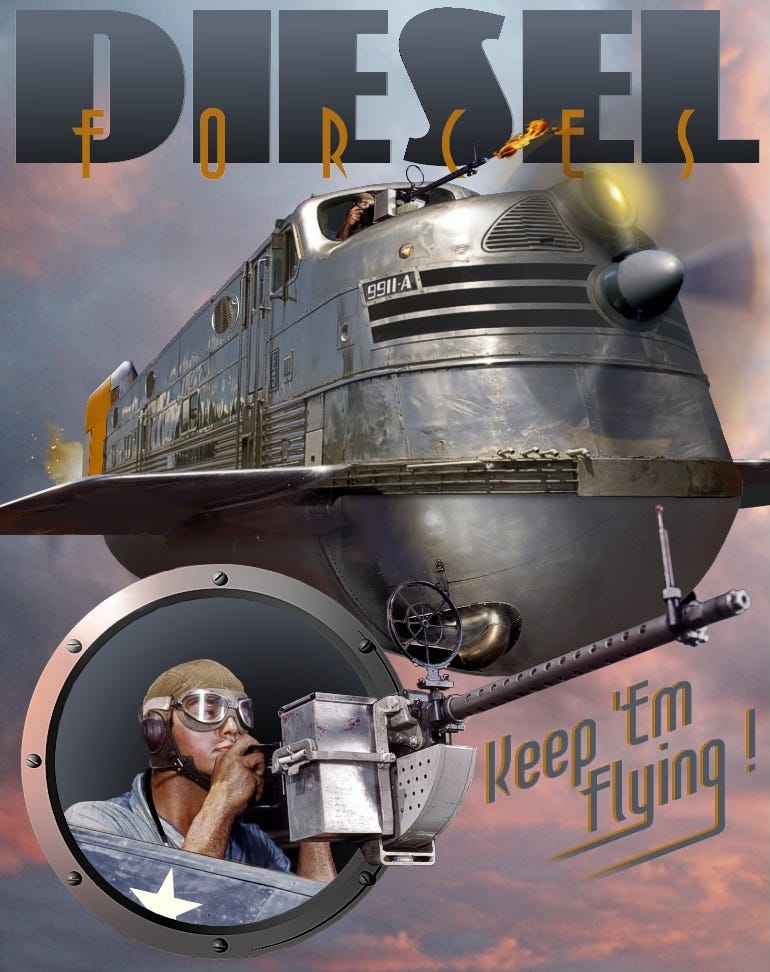
Dieselpunk is similar: the 1940s brought us a certain art style and vision of the future, based on the technology of the time — impressive new diesel engines and dangerous problematic new weaponry. Above, we can see a modern media hearkening back to that style.

Retrofuture aesthetics aren’t entirely in drawn designs. The famous Welcome to Las Vegas sign was made in an architectural style called Googie, a popular style that started around 1945 and was considered to be futuristic at the time: harkening to the ideas of the Space Age and Atomic Age.
Whether it’s Cyberpunk, Synthwave, or even the vibrant shapes and environmentally friendly colors of the humble Frutiger Aero, retrofuturism is all about celebrating what past people thought the future would be like by incorporating its aesthetics into art.
[Retrofuture Commander]
[Zeitgeist]
When talking about retrofuture, the zeitgeist is the key: it is “the spirit of the age,” or our current perceptions. Just as if I were looking to the future, my predictions would be shaped by the zeitgeist of now… 2010 me looked towards the future (which I now call “the now”) with predictions based on the zeitgeist of 2010. In other words, if we want to understand what past commander players would have predicted for the future, we first have to talk about how commander was played in the past, and how some ideas were perceived.
So how was commander in the past? It was slow, chaotic, inefficient, and very very casual. The 100 card singleton rule made it hard to do anything consistently, forcing you to think on your feet, but the extra starting life of 40 helped you live long enough to cobble together something and kept people from getting aggro’d out before cool stuff could happen. Everything about the format was designed to make it take a long time so that more Machiavellian Machinations (not linking to any Machiavelli, you can look it up yourself, lol) had time to play out.
In the early days (1990s!) only the original elder dragons could be your commanders (that’s the eponymous “elder dragon” of Elder Dragon Highlander). All the rules to slow down the game worked out too well, and so they introduced a new rule to speed the game up: It was called “commander damage” and it killed you if any of those flying 7/7s hit you three times.
Think about that for a second. There was a time where our collective idea of a “decently fast game” was one where someone played their 8 mana Palladia-Mors and connected with opponents 9 times (3 times per opponent). Assuming they play their commander on turn 8 and connect every attack, that’s like… 17 turns? Sure they might ramp with a Sol Ring, but their commander could get removed or blocked.
I’m not saying 17 turns should be a low ball estimate of how long your game should last, but hopefully the next time your game pushes 11 turns you can take a step back and appreciate How Far We’ve Come.
[Power Creep]
It’s important to note that power creep is an inevitable part of any game, always has been. Even if the designers do an incredibly good job of making sure that every card is a sidegrade (and not a strict upgrade), simply having more options as more cards come out and then being able to choose the most synergistic option for your deck will lead to the average deck power increasing. In other words: power creep.
We all knew that power creep would occur, and that EDH wasn’t immune.
But, when compared to its contemporaries, MTG was mostly viewed as the “safe” and “conservative” card game. We all saw where Yugioh! was going, Pokémon TCG definitely existed as advertising for the video game more than a standalone product, and dime-a-dozen games like Star Wars TCG and Duel Masters popped up with the expectation they would be out-of-print within a decade (though I was surprised to learn that Duel Masters is still well loved and in-print in Japan - just not in my locality).
MTG designers also had a long history of fairly safe and conservative designs, reprint cycles that prioritized high value old cards over pushing new designs, and fairly conservative power levels… and when something was powerful, WotC often stepped off of the gas for the next set of cards. Speaking of rotation! Another reason WotC seemed so successful at biding off power creep for such a long time was that focusing on rotating formats like Type 2 reduced the pressure to print stronger cards to sell packs, meaning they safely keep the power level low over time while still selling product. Finally… It wasn’t just the designs themselves, but they were on an overall slower design cycle than they are now, with fewer new cards per year — which, with their conservative designs, put projections of power creep at much slower.
Although no one thought EDH would be immune, we also thought that it would be a safer bet than other formats… primarily because back in 2010, Wizards wasn’t designing cards for EDH. The format was primarily comprised of chaff that was too mana-intensive to see play in faster formats, stuff that WotC printed for the Timmy/Tammy types out there to play at their kitchen tables.
Power creep is one example where the zeitgeist of the time limited what they would predict for the future — without experiencing FIRE design, designed-for-commander product, and the crazy rate that WotC’s production speed increased… how would we have predicted that all three would coalesce into a version of commander that’s power crept way faster than previous trends?
[Third Place]
Another ephemeral and irrevocable part of the zeitgeist of late 2000s and early 2010s commander for me is the notion that “commander is a casual format.” It’s not a format where you try to make the strongest deck and win; it’s where you play silly things you think are cool and hang out with your friends. Commander was the “third place” of MTG.
In sociology, the third place refers to the social surroundings that are separate from the two usual social environments of home ("first place") and the workplace ("second place").
If you haven’t seen enough video essays or articles about third places already, it’s any place (such as a library or mall) that allows people to hang out in an inviting public setting. It’s considered to be an important part of social infrastructure since people can meet up with their friends, but also meet new people… and a lot of talk has gone into how physical third places have been slowly vanishing and the ones that haven’t vanished have been slowly becoming over-commercialized and less attractive to visit.
But third places existed in more than just a physical sense, they even existed on the internet! It used to be that webpages were designed as third spaces. Tumblr, Geocities, Myspace, even early Facebook were all pages that inhabited that middle ground between hanging out with your friends and meeting other real human beings. Now they’re apps that profit off of monopolizing your attention and have no intention to be much else — any upside they provide to the user is just a lure to get you to give them more attention so they can profit.
Games have also functioned as third spaces: Runescape, WoW and League of Legends used to be like "third places” of the digital world. Similarly to other third spaces, these places have crumbled with over-commercialization. I’m still friends with multiple people I met on League (one of which has even visited me in-person) — but now League of Legends has been so streamlined towards grinding ranked points, that it feels downright impossible to actually meet new people (it can even be surprisingly difficult to to play with the people you already know). The only people still playing Runescape are so dedicated to the hardcore grinding that they neglect to actually meet people they’re playing with… and sometimes neglect to even treat them as people.
The epidemic of losing “third spaces” is an epidemic of things that were attractive places to hang out becoming streamlined profit machines. Goodhart’s Law strikes again! The more companies target profit as their measure of success, the more these places become streamlined to get you in, get you to make profit for the company, and to clear you out as soon as you’re done making profit. This applies to MTG, too.
To get overly cynical for a second: Many modern cards are not designed to connect you with your friends, encourage you to DIY lasting gameplay experiences, or draw you into the larger MTG story; they’re designed to get you to buy more product by being ever more powerful than the last set of cards. Nowhere is this more apparent than Universes Beyond cards, where the mystique of the magic story is effortlessly discarded for the sake of more card purchases. WotC makes way more money from a player who buys a powerful set of cards, uses them, then buys the next set of even more powerful cards than they do from someone who has spent a long time in their ecosystem building a memorable deck that they love from scrap parts.
More evidence of this change is when players expect games to be short in-and-out ordeals, similar to fast food, when most real hobbies that create community are very much not. A relaxed Warhammer game at 2000 points takes between 4-5 hours. Just one LOTR movie takes 3+ hours. D&D sessions run for 5+ hours and multiple visits. Has anyone ever played Civ? Hobbies that act as third places are not in-and-out ordeals, and the more we treat our game like fast food the more we degrade it’s place as a “third place” and turn it into another consumerist profit-machine that we can only either consume or over-consume… but never actually unplug from.
Ok. That’s enough negativity. I promise I do love this game, and have a lot of positive things to say about Wizards of the Cost and many of the amazingly talented game designers therein. But I think that fighting to maintain commander as a third place, instead of letting it just become a hyper-processed fast-food-style experience of a game, is a big part of [bracket 2] commander’s retrofuture aesthetic… and for a lot of people, that includes avoiding a lot of the hype-generating hyper-popular hyper-streamlined for-commander cards.
In my mind, the zeitgeist of 2010 envisioned EDH as a sort third space, so naturally someone playing at that time would’ve predicted that MTG in 2025 would also function as one. But over time WotC has invested less funding in things like LGS support, tournament programs, the judge program… and started designing for raising their profit line.
[Conclusion]
The general conclusion is that, while playing commander in 2010, if asked about what commander in 2025 would look like… we would have a completely different image than what it actually looks like. We expected new cards, but less power creep, less streamlined play, more slow durdly games, and to preserve the feeling that the game is a “third place” and not just an in-and-out play-to-win for-profit grindfest.
Many non-beginner players who play in [bracket 2] are trying to live that image in modern games. The lower power of the bracket means they can avoid the keeping up with the joneses that happens in higher power levels, they can avoid power creeped cards and comfortably not play certain stuff they don’t like. They can cosplay as the image of the future they were promised in 2010: so I have dubbed them “retrofuture players.”
Obviously this article is discussing a broad generalization, and we should always remember that sweeping statements are not true for every case. But hopefully this article has provided a little bit of extra illumination on the mindset of some subset of [bracket 2] players.