
How I Manage Tokens
Battlefield Aesthetics

The Why
I’ve brought many new players into this game (often by having them build the first commander I built — Merieke ri Berit — yes I have been very evil, though these days I advise against such cruelty), and when teaching them they often quickly discover something: a commander that seems fairly straightforward, such as Krenko, Mob Boss or Ghired, Conclave Exile, can quickly become a logistical nightmare when it comes to how you represent your tokens on the battlefield.
I’m a huge fan of smaller, more uncluttered boards (I even have a history of using Homicidal Seclusion and Deadly Wanderings), but I’ve seen a lot of crazy board states too… for example: Precursor Golem targeted with a kicked Rite of Rep… several times.
Many new players have, at some point, asked me the easiest way to keep track of and represent tokens.
The How
In my opinion, token management starts in deck building. When you look at any decklist on Moxfield and scroll to the bottom, you can easily see how many different types of tokens a deck makes and what they are. At the time of writing:
My Teysa (Aristocrats) deck can make 7 kinds of tokens (ostensibly, a deck based around tokens)
My Aurelia (Aggro + Goad) deck can make 5 kinds of tokens
My Gyruda (Demon Kindred) deck can make 4 kinds of tokens
My Venser (Poison & Proliferate) deck can make 2 kinds of tokens
The easiest way to manage your tokens is to reduce these numbers: A deck with 4 possible token kinds is a less convoluted logistical situation (and a less cluttered board) than a deck with 10.
Frustratingly, this has become more and more difficult over the years of modern MTG design. Why does Bitterblossom make black Faerie Rogues while Bitterbloom Bearer makes blue-and-black non-Rogue Faeries?! Why do Inklings now come in a 2/1 variant and a 1/1 variant?! Reducing token counts for me often means making tough choices to cut cards that produce unique tokens, or to run only one version of a token type even when both cards would be good in the deck.
This, by and large, is also my grudge against the dungeon mechanic. Some people may enjoy that sort of board, but managing the logistics of that is something I view as an unnecessary complication/hassle.
The How How
Once I’ve decided how many tokens are in my deck, how do I manage them? The first important thing is to actually purchase the correct token and keep them close to your decks for easy use. I usually purchase just one of each token, because it’s all you need for what I find to be the simplest and most visually clear method of managing multiple tokens:
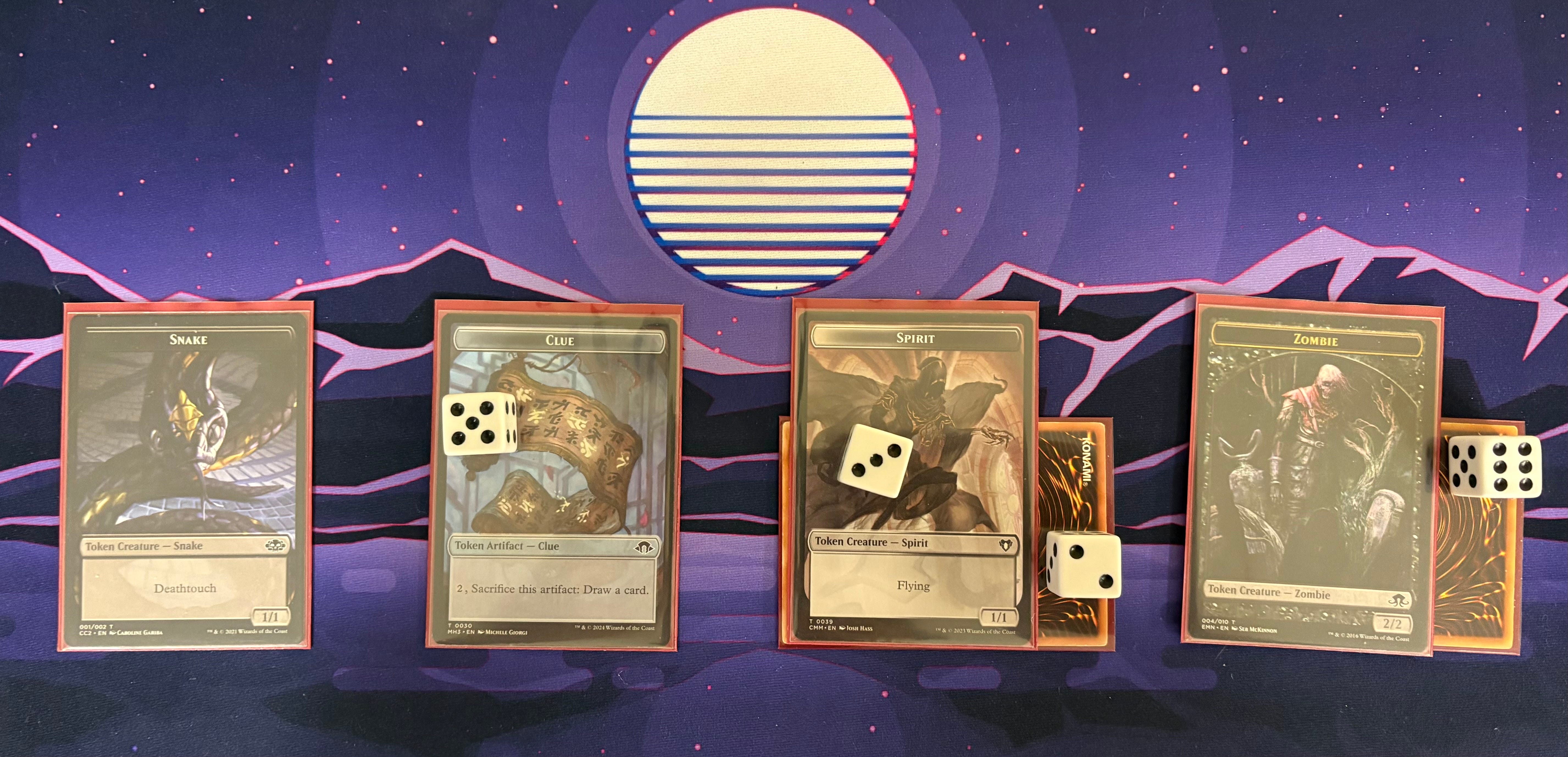
(Pictured, from left to right: 1 untapped snake, 5 untapped clues, 5 spirits (3 untapped, 2 tapped), and 6 tapped zombies)
Put one of that token down, and put a tapped card underneath it. The tapped card can be anything (another copy of that token, a Copy Token, a face-down card, etc) but I tend to use Yugioh Cards that have been sleeved face down. I just like their aesthetic, plus the standard YGO card size is smaller than a MTG card, so the setup can take up just a little bit less space on board. Use dice to represent the number of tapped and untapped tokens you have, moving from the tapped to the untapped cards as necessary
Often if a token (such as Clue) doesn’t require tapping or if I have just one copy of the token out, I’ll skip the facedown card and only add it if necessary later (because I generate more of them, or some of them get tapped somehow).
For tokens I make with my commander, I sometimes purchase a few more (about 5) of them so I can put a few more of them on the board. This is unnecessary but for some reason I find it to be sort of aesthetic to have your commander surrounded by the tokens they made:
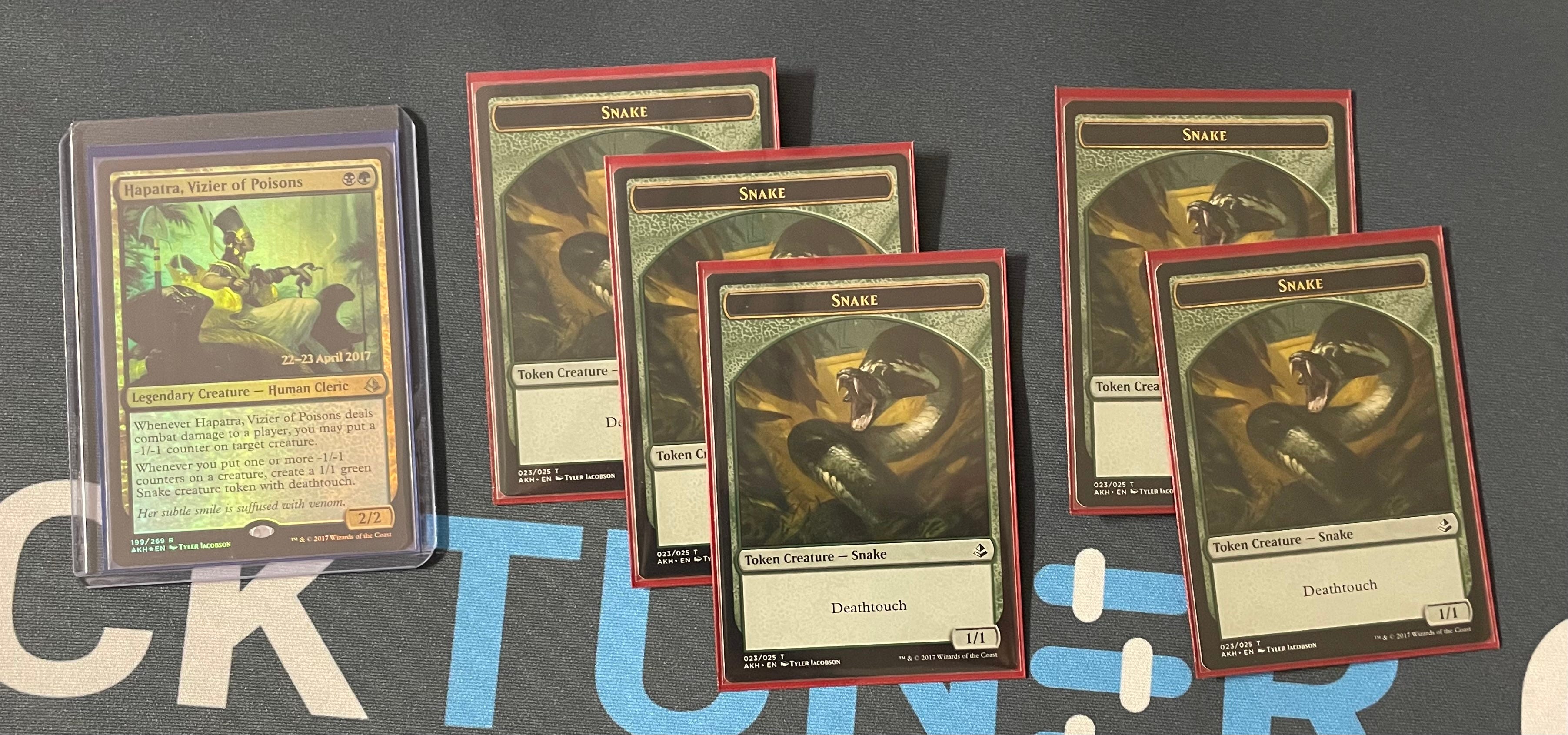
Even though this step is unnecessary, it’s not without a needless scientific explanation.
Right after writing this article, I watched a video made by The Professor (it’s improbable that you’re reading my article without knowing who he is, but just in case here’s his channel and the aforementioned video and I highly recommend both). In that video, he talks about coming to EDH games prepared with the number of tokens necessary for a game, as if you’d just lay out ten tokens on your board. I find that to be a huge hassle.
Subitizing vs Enumerating
(the superfluous part where I apply concepts where they don’t belong - yay, science)
To step away from MTG for a second… When we have an unknown number of objects of any sort in front of us and want to know how many there are, our brain two processes that might lead to finding out what that number is.
Enumerating, in this context at least, basically means to count them one by one: if there are sixteen tokens, you count (“one, two, three, four, etc”) all the way to 16 while indicating mentally which ones you’ve counted so you don’t count any individual token twice. This process is slow, reliable, and necessary for large numbers of things.
Subitizing, by contrast, is just as reliable but is near instant. It comes from the Latin “subitus” which means “sudden.” Basically, when you look at a small enough group of things, you can just suddenly know how many there are without counting. The average adult can subitize around four or five objects, so if there are three dots, you likely don’t have to count them to know that there are three. Once we have six or seven items, however, it’s hard to subitize unless the items are arranged in a familiar pattern… so we must resort to the previous method of enumeration.
To step back into the realm of MTG and keeping track of tokens… if we have 1, 2, 3, 4, or 5 tokens, it’s easy to subitize and see how many there are. If we have more tokens than that, when we would need to enumerate, we instead switch to the stacked method described above for representing tokens. Six-sided die sides are all laid out into what researchers would qualify as “familiar patterns,” so even if we can’t subitize them we can instantly recognize which pattern corresponds to which number… and we can subitize about 5 six-siders before we must start counting them.
Tokens with Counters
This is a situation I’d rather avoid. Cathars’ Crusade may be really powerful in a token spam deck, but I find it to be not worth the effort of carrying around a ton of tokens for it or figuring out how to represent it (and some other popular MTG content creators agree with me). That said, sometimes this is unavoidable! Sometimes an opponent might put counters on your creature with something like Shadrix Silverquill! Unfortunately, outside of just having more copies of your tokens (or Copy tokens), there’s no graceful way to represent this.
Flip Cards
This is the part where I may look like America’s favorite dad, but I really hate the idea of sleeving and unsleeving cards during a match. I want my card to stay clean, protected, and in good shape (after all, I own some expensive pieces of cardboard, don’t you?). But this means that if I have a flip card, I really don’t want to physically pull the card out of its opaque-backed sleeve to flip it over.
If I have flip cards (such as a MDFC or Writhengar), I tend to keep a second copy of that card in my token box, sleeved with the flipped face facing outward. For this reason, I also try to limit the number of flip cards that I use (though as I mention in my MDFC/HGDC article, I always recommend running a MDFC land spell if you can help it). So I’ll keep the extra copy with my tokens, then in the middle of the game if it flips, I trade it out from my deck for the properly-sided version.
Since I keep an extra copy of all my flip cared in my token box, it’s really important that the extra copy has a different color of sleeves than my decks so that they don’t accidentally get shuffled back in. This is part of the reason why I color-code my decks. I use Dragon Shield Matte MINT for my decks, Dragon Shield Matte RED (discontinued? But they seem to be the same as RUBY) for my tokens, Dragon Shield Matte CLEAR for my MDFC backsides, and Dragon Shield Matte PURPLE for everything else (since I play on webcam/convoke I like to keep a few things my opponents might put on my stuff like Imprisoned in the Moon on hand).
I use Dragon Shield re-sealable perfect fits for the inner sleeves (here’s a short, sweet, and ancient Professor video about double sleeving). [Insert obligatory “I am not sponsored by Dragon Shield and make no money in commissions. If you work for Dragon Shield and want to send me money, please do” joke here.]
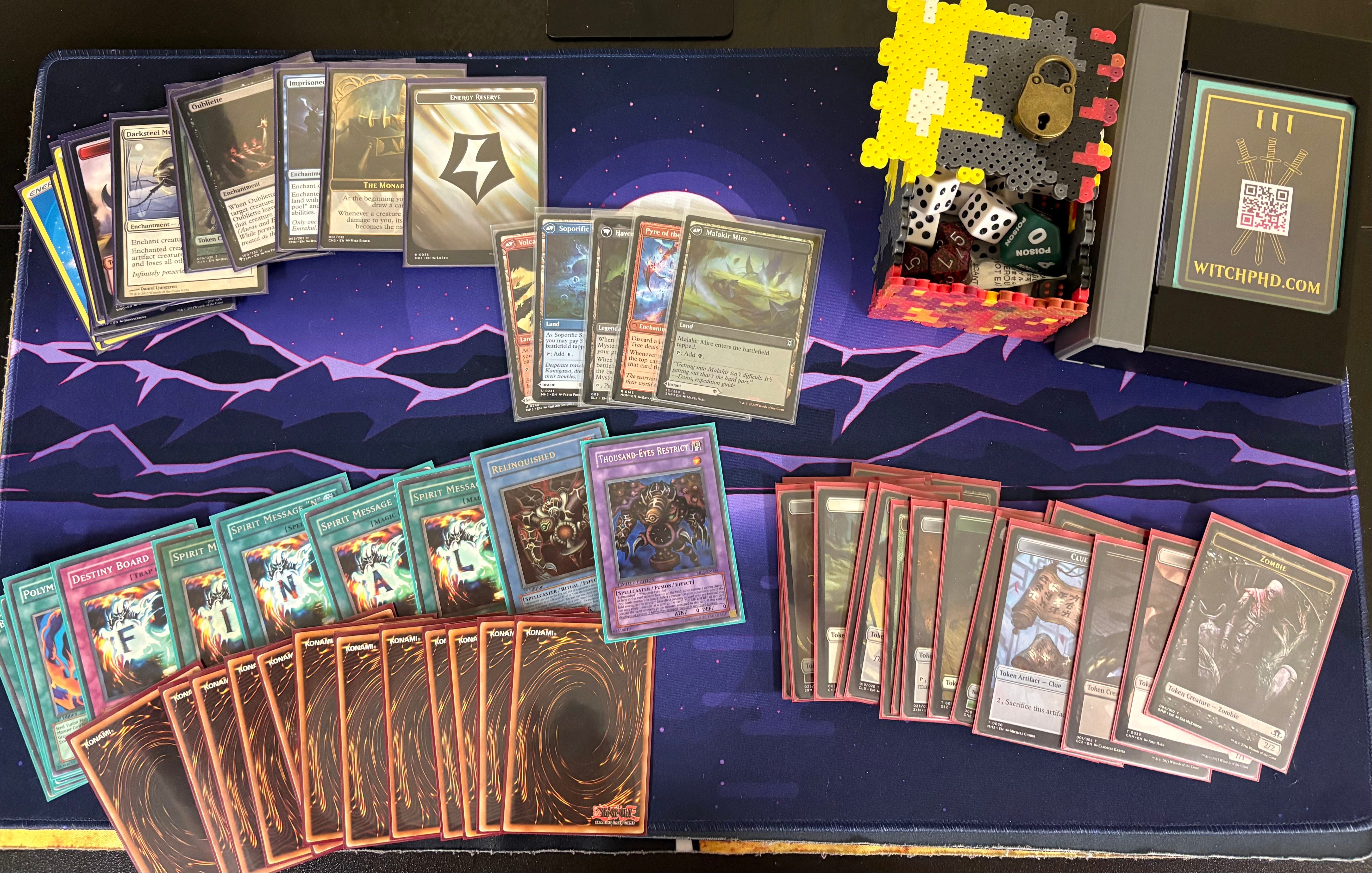
I also keep some funny un-cards in Dragon Shield Matte SILVER so I don’t accidentally shuffle a Cheatyface into my deck. I also keep my commanders in Regular UltraPRO Toploaders to help identify their “commanderness” if they happen to get morphed. This also means that I can treat them a little more aggressively and toss them around a bit more… and they fit nicely into the deckboxes I use - Commander Flatpacks (By CabalCoffees).
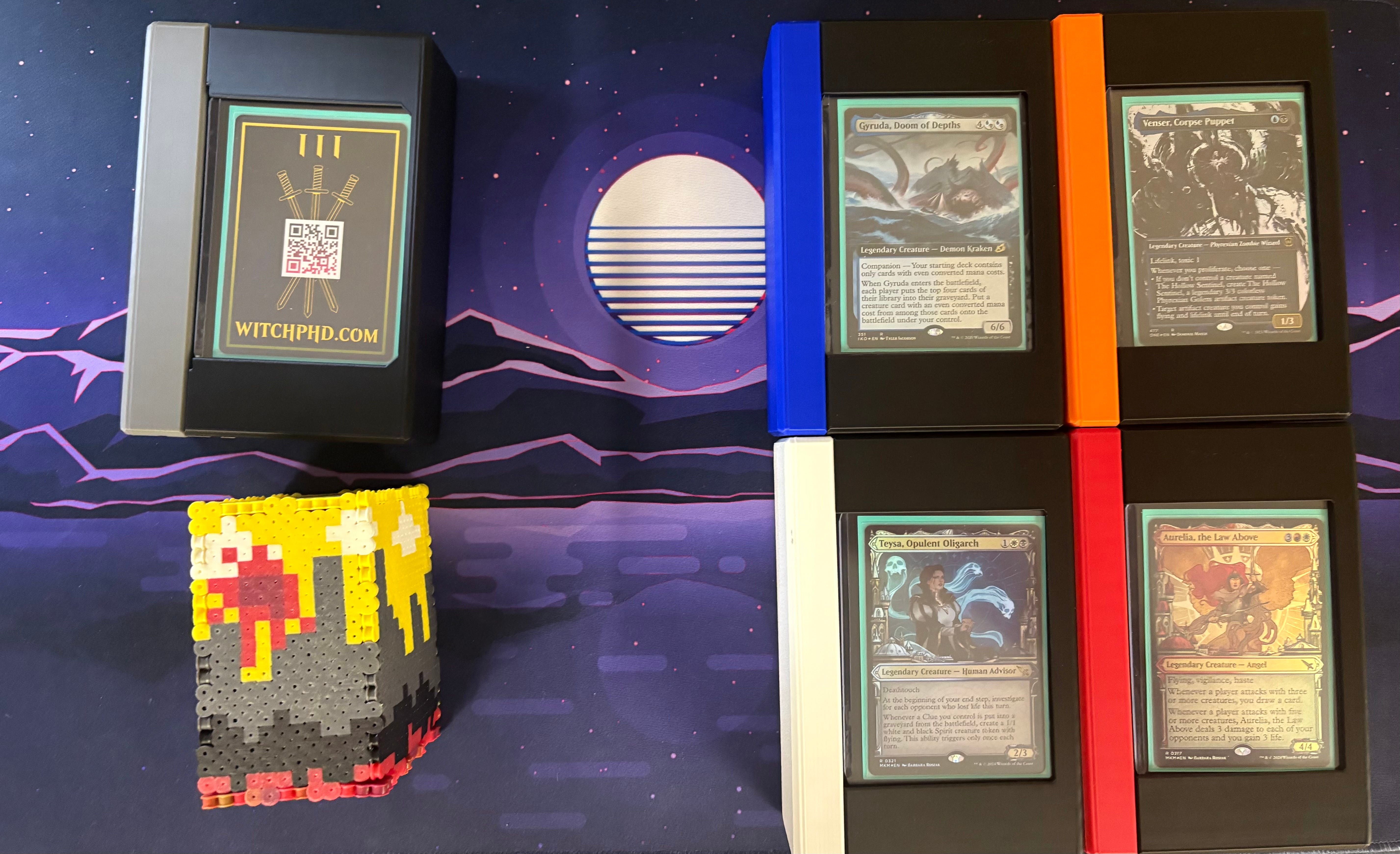
Anyway, this article is supposed to be about tokens… not “a complete WitchPHD™ guide for managing your game pieces and playing space.” So let’s move on.
Note From the Future
Hey. It’s Witch From the Future here…
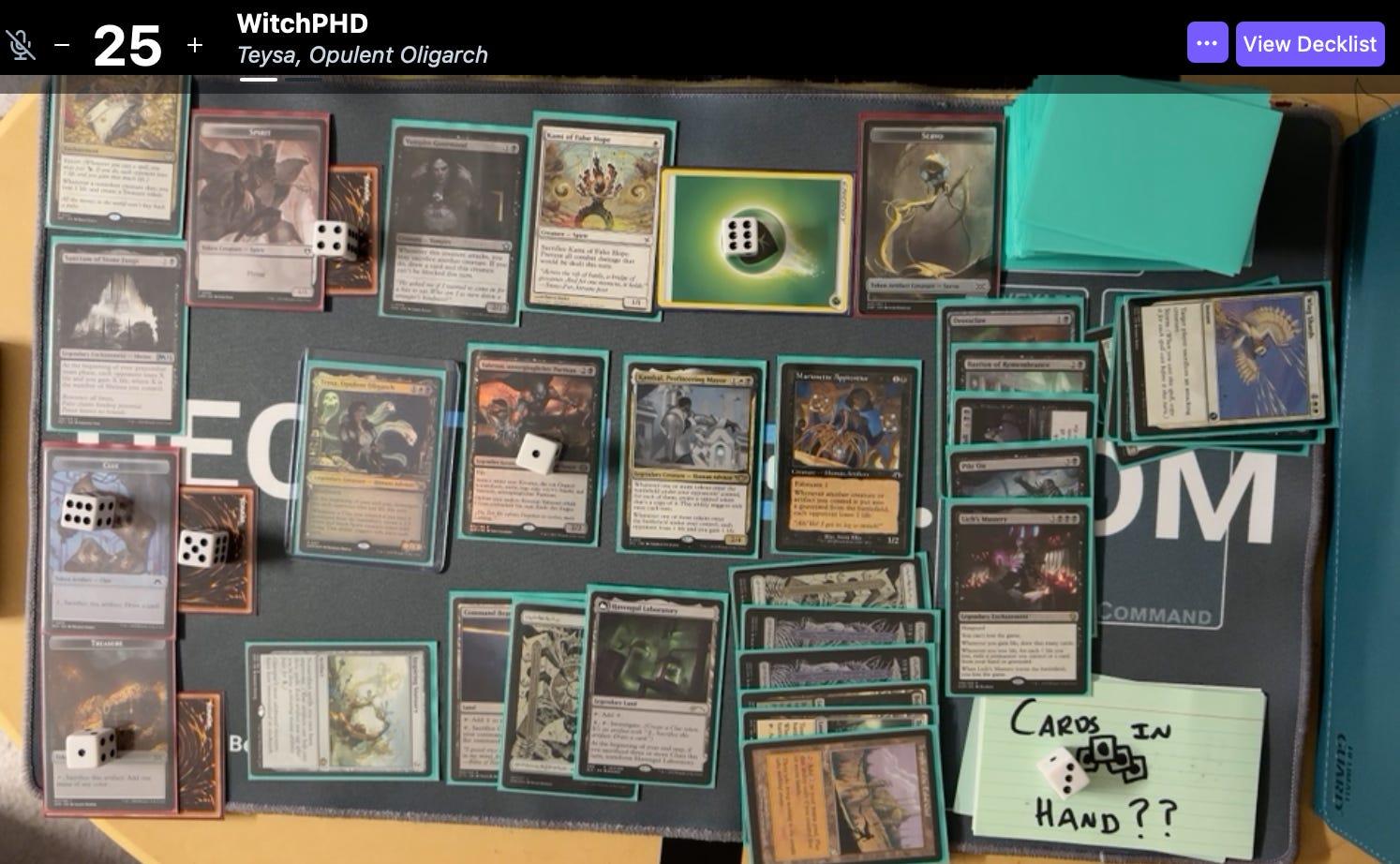
Even with this technique board states can get a little bit messy (though I don’t dare think of how messy this board would look without this technique).
Ultimately
You can do what you want; I don’t expect most people to adopt my eccentric habits of managing flip cards or avoiding running dungeons and werewolves or whatever. That said… some of you might find this method of keeping track of tokens to be useful to you. Let me know if you do! Let me know if you want me to write “a complete WitchPHD™ guide for managing your game pieces and playing space.”
Or, perhaps, if you have a better method I should try, feel free to leave it in the comments.