
Balala
I played Balatro, I tell you what

One year ago on this day, I started playing Balatro, a game that received several Game of The Year nominations in that same year (and won a few categories). I primarily played on my phone (iOS), and spent a long time playing… so I wanted to write about my experience. This article has very little to do with my usual fare (MTG), so take my opinions with even more salt than you normally would… and of course, spoilers for the game ahead.
The first thing I have to say that is that I cannot sing the game’s praises enough. Positioned as a poker-based roguelike it seemed like a rough proposition, but for a mere $10 on iOS store I’ve gotten a seemingly endless amount of fun. The gameplay, the sound design, the art, and the intelligent-but-quirky tone. Highly recommend. Secondly, I give my thanks to the community over on r/Balatro. Not only have they been greatly positive over the year I’ve been playing, but they have brought me a lot of similar joy as r/CustomMagic - as people are always designing new jokers, cards, and art.
For the general layout of this article: first I’ll finish this intro, then I’ll describe the general gameplay for people who haven’t played, then I’ll describe my experience with each deck and some challenges, then I’ll get into some misc things that helped me when playing the game, then finally I’ll briefly touch my favorite strategies and cards. Feel free to skip ahead (I think the tips and tricks might be most helpful if you’re currently trying to beat the game).
How far did I get in the game?
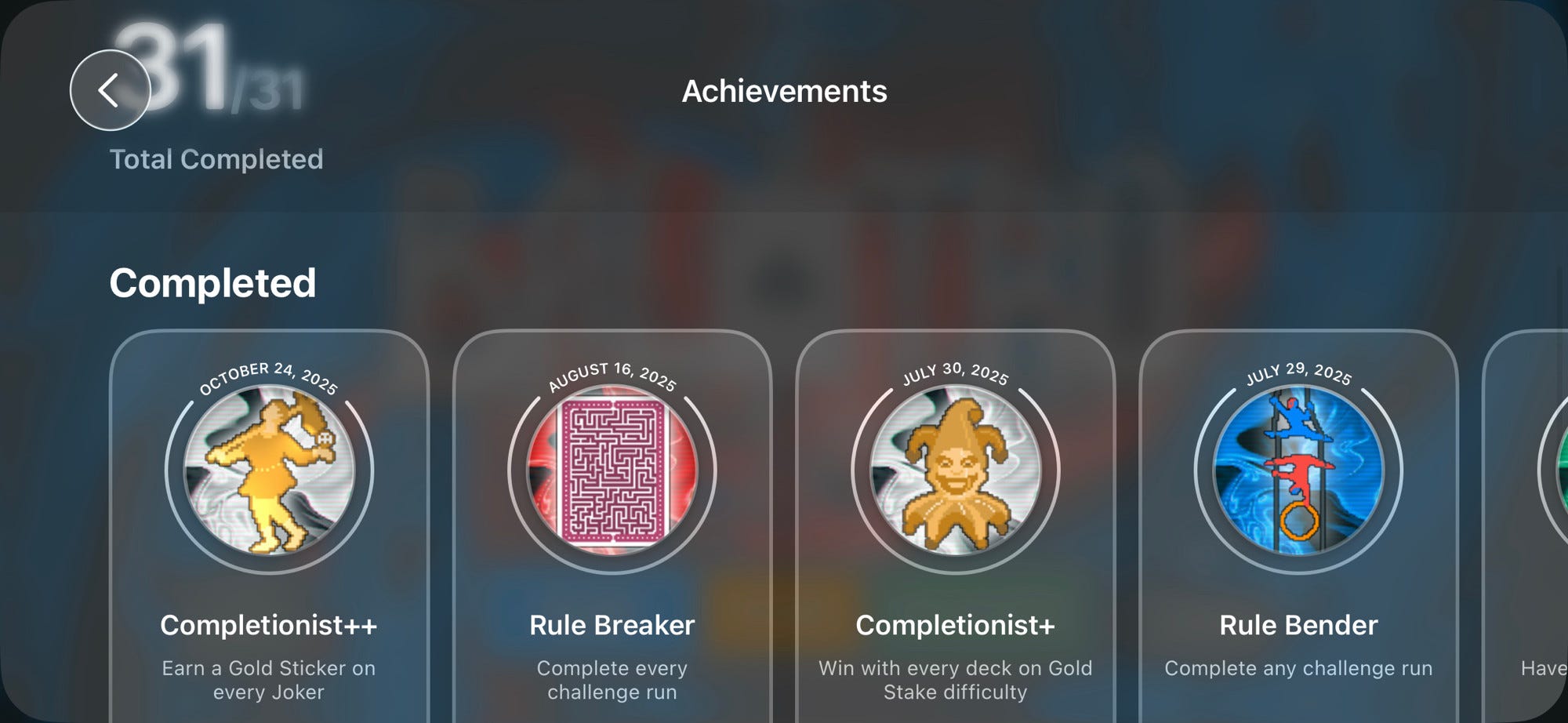
I started the game on December 18th, 2024.
Tier Lists
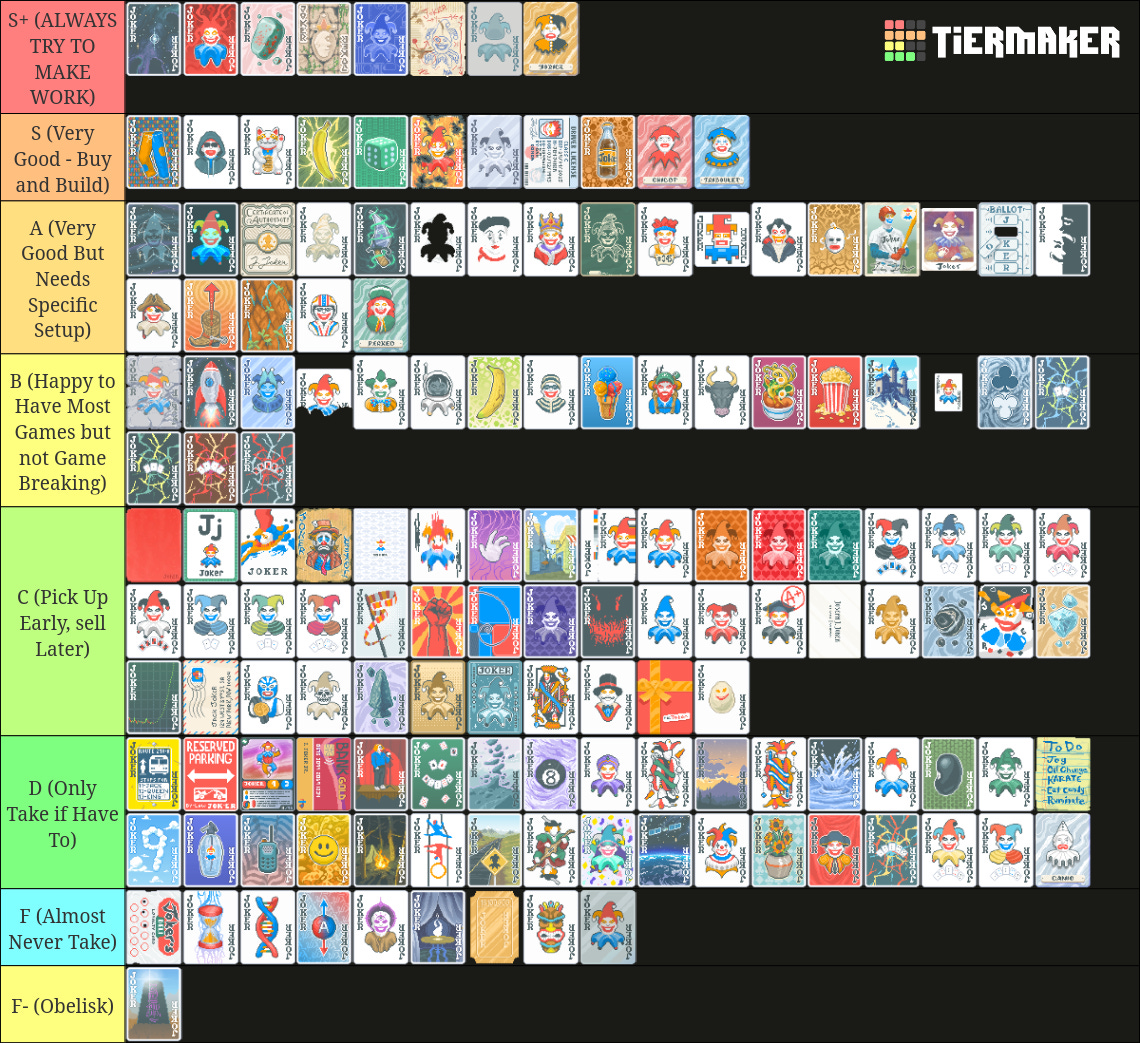
For fun, I used made a tier list of jokers on Tiermaker. Here it is:
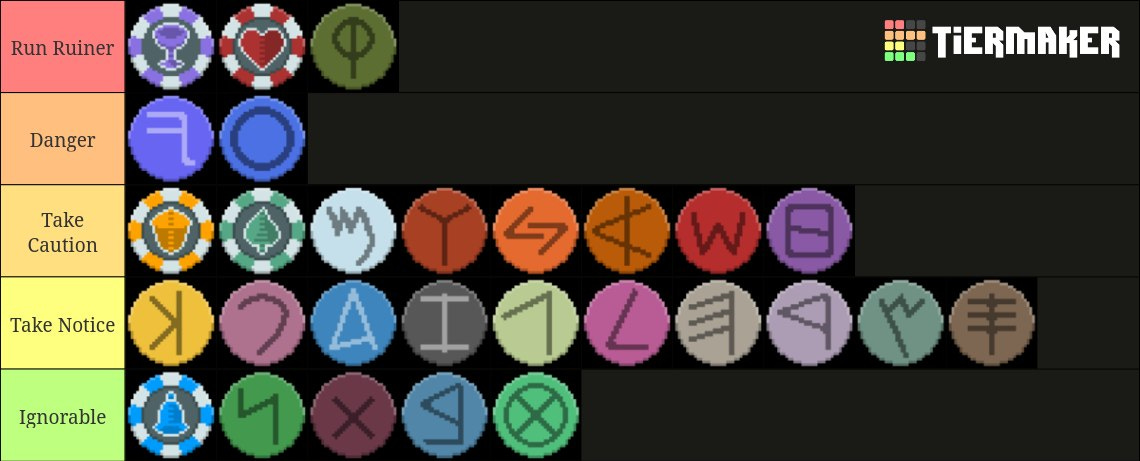
Similarly I made a tier list of bosses.
Gameplay
If interested, I highly recommend you go play the game. It’s incredible cheap, it’s available on iOS, Play Store, Steam, and a few other places. Here’s a brief overview of how the game works:
You start with a standard deck of 52 cards, and have to to play standard poker hands. Each hand scores two numbers: “chips/blue” and “mult/red” which are multiplied to get the final hand store… and if you get the required score for the round in the number of hands allotted, you beat that round (called a “blind”)
Based on how you did that round, you attain $ which you use to buy several types of power ups:
Jokers sit above and are the primary way to power up your score potential
Planet cards are consumables that increase the level of their connected hand so they have more base points
Tarot cards altar your deck in some way, adding or removing cards, or giving cards editions or conditions that provide them with extra effects
Spectral cards have… various effects
Vouchers permanently alter the rules of your run
You can buy additional cards for your deck
Each “ante” consists of three blinds, the third of which being a “boss blind” that has special effects like disabling certain cards. But as you progress through the antes, you get more jokers, edit your deck more (even gaining access to hand types that are impossible in traditional poker, such as 5-of-a-kind), and otherwise try to progress to get higher chip scores to beat bigger bosses.
The game is a roguelike, meaning the shops and packs you open (and the bosses you battle) are generated randomly each run… and if at any time you fail to beat the score, your run is permanently ended. But, like other roguelikes, you gain access to more unlocks the more you play through the game giving you more things you can find in other runs.
Ante 8 has a special type of boss blind called a “showdown boss blind,” which typically has a bigger and badder effect than other boss blinds. If you beat it, you win the run (though you technically can play the run past that). There’s several decks that alter how the game is played, and each deck has several difficulty levels.
My Gold Stake Wins
In order to beat completionist+, you have to beat all the decks on the highest level of difficulty they offer (called “gold stake”), so here’s my experience going through each deck.
Checkered Deck — The first deck I played to compleation is the checkered deck. Having just gone through the process of unlocking all the decks and beating at least first stake on them, I still didn’t have a good idea of what good strategies and cards were. I figured that this deck deck simplifies one aspect of that by making it super easy to get a flush: just +1 hand size guarantees that you’ll have a flush, which is a decently scaling hand, every time. The playthrough went smoothly enough, and I stand by that this is one of the easiest decks to play on. It can really get halted by some Boss Blinds, though.
Plasma Deck — Another case of trying to understand the game better by reducing the number of things I have to worry about (so I can focus on smaller, more parse-able chunks at a time). At first I thought that it would be really simple to beat, since it equalizes chips and mult, it means that building a bunch of chips jokers should scale me to victory. This turned into a valuable lesson about the game’s scaling, though, since my final Plasma run did require me to build multiple xmult jokers (jokers that multiply the amount of mult you have). It turns out that, even on this run, xmult is the most powerful thing you can be doing.
Blue Deck — So far I had been picking which decks I thought would be easiest based on my ideas… but on r/Balatro they seemed to have a different idea of the best beginner deck. Since I was still a beginner, I decided to take their advice. Blue is a simple deck, that has all the elements of the game accessible to it, but it gives you an extra hand to beat each blind with. Also, since you get an extra $ at the end of each round for each unused hand, you get more economy as you play with your extra hand. This was also the first time I earned any tags, because I didn’t learn how to skip blinds until somewhere in my Blue deck climb.
Ghost Deck — In my forays with Plasma and Blue, I learned that xmult is top dog in the Balatro ecosystem (Plasma wishes there was an xchips). Ghost gives you a free hex card, which will give any joker 1.5x mult… meaning if you pick up any good joker early you can turn it into a source of xmult. Also, this deck lets you pick up Spectral cards, which are real wild cards that have a variety of effects. I think that, out of all of the decks I played, this is my favorite to have a good run on. Also, out of all the decks that I played, this is the one where I restarted after my first shop the most often, after not seeing any jokers worth hexing.
Abandoned Deck — There was no real logic for picking this one. I had just finished Ghost and no decks were standing out to me in particular. A lot of my runs so far had been predicated on flush or 2-pair, with a focus on using face cards. This deck has no face cards. I experimented with some full houses and such on this deck, as well as some other hands like 4-of and 5-of. Overall, the deck comes with deck fixing by default and predictability is power. Early in the game not having any face cards hurts since it means you can’t beat the early blinds in as few hands and you end up with less $. Late game, a 2 and a king really aren’t that different, and the 8 extra chips doesn’t amount to that much.
Nebula Deck — All of my runs predominately focus on a single hand. Pretty early on I’ll get a joker, a card, or something else that sort of dictates what that hand would be… and then I lean into playing that hand as much as possible. This deck was dead-simple, since it makes it super easy to gain access to planet cards to level up that hand. That said, the gold stake gave me unexpected trouble, with me falling short on several occasions.
Yellow Deck — I wanted an easy deck to re-set from the difficult gold stake of Nebula, and this deck fit the bill. It plays just like the base game, but you get extra gold to start out. This is the first deck I really tried straights on, and it went pretty well (straight scaling is really good and Runner is insane). No real comments. Easy deck easy life.
Red Deck — At this point I had been through about half of the decks, and I just started going in the order they are posted in the game. I’d get to them all enemy, so why pick and choose in a random order? This is the very first deck, and in hindsight it felt really weird that it took me this long to beat the first one. No real comments. It’s just Balatro! It’s just the base game!
Painted Deck — Since I was more than halfway through, I figured it was about time to start filling out my collection. I started scouting for jokers and consumables I hadn’t unlocked yet, and tried to specifically seek out the unlocks. “Discard a royal flush,” “play four 7 of clubs,” and “play 5 gold cards” all seemed like they lined up well with a deck that gives extra hand size, too. Ironically, on the first stake I got Burnt Joker and Astronaut, and played a high card run. I did unlock all the aforementioned unlocks, though.
Zodiac Deck — Unlocking consumables is a two step process, and though I unlocked all of them in the previous step, they still show up as ?? in your collection until you actually buy them. This deck gives you a few extra vouchers, and conveniently that meant that I was more likely to see (and thus be able to purchase) my last voucher unlocks.
Anaglyph Deck — This deck rewards you for skipping things by giving you extra double tags when you do. Like Ghost it feels very reliant on “how good your random seed is,” and therefor your success is inexorably tied to something you have little control over. Ghost has the decency to let you re-start after the first shop, but you don’t know if you’ll get a good skip tag later in the run or not until you play through the run. The highs of getting a ton of double tags triggering on a Negative tag are real… the lows of being on ante 7 and having never hit a single tag worth doubling are also real. This deck is also when I finally made the jump from 2x speed to 4x speed. Not sure that’s relevant, but it’s a note I wanted to include.
Magic Deck — Very different from the type of Magic Deck I usually talk about on my substack. This one just gives you some free extra tarots. All is well and good, as tarots are great value for deck-fixing, to help ensure you craft all the odds in your favor (as well as get cool extra chips and mult on all your cards). Overall, a fairly straightforward deck that has less of a “gimmick” and more of a “slightly altered starting condition.”
Black Deck — Ok… so I was going through decks in order, but I was a little nervous to play Erratic Deck. I vastly underestimated how hard this deck would be (it’s harder than Erratic, I think). More joker slots means you can score higher per hand, but fewer hands per round means you have less chances to play those higher scoring hands. One effect I vastly underestimated is that it also means less $ at the end of the round for unspent hands, so slower economy buildup.
Green Deck — Green deck was probably the fastest and easiest deck for me to beat overall. The decks gimmick gives extra early economy, helping your run start off on a strong foot… but the deck forces you to adopt different habits to get that economy. Previously I had really lamented and avoided jokers that made me feel bad for avoiding a resource (such as getting gold per unused discard) and tried to bank at least $25 so I could get that interest… but this deck has you save those resources and gives you no benefit / interest for $ sitting around. The extra economy makes the run overall easy, and that’s something I definitely could take advantage of given that, by this time, I’ve learned a lot about the game and have a lot of experience in valuing how to spend my hard earned gold. Note to self: cards that alter interest such as Seed Money have no effect, please stop snap buying them
Erratic Deck — Honestly this deck wasn’t as bad as I thought it would be. I saved it for last but overall it wasn’t that hard. Just look at your deck when the round starts every time, and you can make an educated guess on what sort of hands you should probably build. I got stuck on Gold ante 8 for a while. I had a cool 5-of-a-kind run where the deck just naturally spawned with a ton of kings… but I failed to get all five kings on the final round. My final gold run went to ante 12 with several copies of Bloodstone with OOPS!
Challenges
After beating all the decks on gold, it was time to go into challenge runs. Honestly most of the challenge runs are pretty easy compared to gold stakes, so many of them were easy to sweep at this point.
By far the hardest challenge was “Golden Needle.” This challenge applies the Boss Blind known as The Needle to every round, meaning you can only play one hand per round. This challenge ALSO makes it so that you have a lot of discards to sculpt your hand, but you lose $ every time you discard. An overall frustrating challenge since it is genuinely difficult to get enough chips and mult to beat all the blinds in a single hand, and you end up bleeding your economy as you try to sculpt your winning hands. My winning build was a photochad build that included some good poly cards.
Jokerless is the infamous final challenge run, requiring you to beat the run without buying any joker cards. Honestly, it wasn’t as hard as Golden Needle, but it wasn’t easy either. In order to beat this run I kept plugging in equations into wolfram alpha to find out what level a hand would have to be to beat 100,000 chips without any alterations.
The formula for how high level something has to be to beat something in one hand is simple
( [base chips]+( [planet chips] X )) * ( [base mult]+( [planet mult] X )) = 100,000
The 5-of-a-kind hand only needs to be level 27 to beat 100,000 chips in one hand:

A certain thief of light would approve of me playing “5 of a kind” with a hand full of 8s.
Also, you can tell I don’t make good use of glass cards. Pretty much every other jokerless run I’ve seen uses a lot of glass cards, but I used just one and it was because I got a boss blind that increases the chip requirement.
C++
Each time you beat a run while a joker is equipped, it gets a sticker corresponding to the difficulty of that run. In order to get Completionist++ you have to get a max-difficulty sticker on every joker.
My go-to decks for grinding C++ are ghost (any joker is at least kinda good with hex, plus spectral cards are just fun to see more often) and checkered (great for turning your brain off and just trying to grind wins). I did play blue deck specifically to get gold sticker on Loyalty Card (with just one hand size voucher you can trigger it every round).
Many jokers are not good core parts of a strategy, and food jokers (jokers that decrease in stacks and eventually disappear) are particularly difficult because of the fact that they vanish outside of your control. My last Joker to get was Turtle Bean and I had a few frustrating runs where I just couldn’t line it up to still be around during ante 8.
Note: I also learned via experience that food jokers lose their stacks and vanish BEFORE stickers are applied. I had a run where Turtle had 1 stack left when I defeated the boss blind, and it vanished before I got the sticker.
Many of my C++ grinding runs were just building a good core strategy and building econ, then re-rolling the last shop in hopes to add a joker I’m missing at the last minute.
Also, between C+ and C++ I started playing a LOT more Pair. I think the reason I’m drawn to Pair (and virtually never play Straights) is the same reason I’m drawn to [bracket 2] in commander:
If I’m going to lose, I’d rather lose after playing my hand, instead of not getting to play it.
The play pattern of Pair makes it easy to play the hand, and the challenge is scaling the hand up… compared to Straights which are easy to scale up but often leave you stuck unable to find and play them
How much XMULT is some number of 1.5X mult cards worth?
Ok… on to the tips and tricks segment. It’s really easy to find out how much some number of 1.5x mult cards are worth.
So the most common small denomination of xmult is 1.5x — this is what steel cards, polychrome cards, baseball card, and so on and so fourth give. To make it easy, we will do math on 10 mult, and say we have three of them.
To reverse engineer, we just have to put it in the opposite direction:
In other words three instances of 1.5x mult is equal value to one instance of 3.38x mult.
You can do this math on any amount, but what it boils down to is that “multiple instances of small xmult” are usually more valuable than you would initially guess.
Please Excuse My Dear Aunt Sally
So another quick lesson that I learned is that you have to pay attention to the order of operations that things trigger in.
Boss Blind effects (such as The Arm)
“On played” joker effects (such as Green Joker’s scaling or DNA)
Played cards from left to right (for each card: chips, then editions/effects, then Jokers that trigger like Photograph, then retrigger effects like Red Seal )
Cards in hand from left to right (like steel cards and Shoot the Moon)
Your jokers from left to right.
The voucher “Observatory” if you have it.
Last is the chip and mult equalization from the Plasma Deck
xmult is insanely valuable, but it gets more valuable when +mult happens before it. So having +mult earlier in the sequence and xmult later in the sequence is optimal. This is one of the reasons observatory is so strong (since it gives xmult at the end), and one reason I’ve found photochad to be quite finicky since it gives xmult in the first step (when cards are triggering).
Graphing Planets
The formula for how high level something has to be to beat something in one hand is simple
( [base chips]+( [planet chips] X )) * ( [base mult]+( [planet mult] X )) = 100,000
As an aside, if you want to graph the base score of a scoring hand based on its level, you can use this formula and use Y instead of 100,000. Keep in mind that “X=0” will be level 1, “X=1” will be level 2, and so on and so forth. I’m just going to use an online tool to graph flushes:
Flushes start at 35 chips and 4 mult… and each Jupiter gives 15 chips and 2 mult. So the formula is:
y=(35+(15x))*(4+(2x))
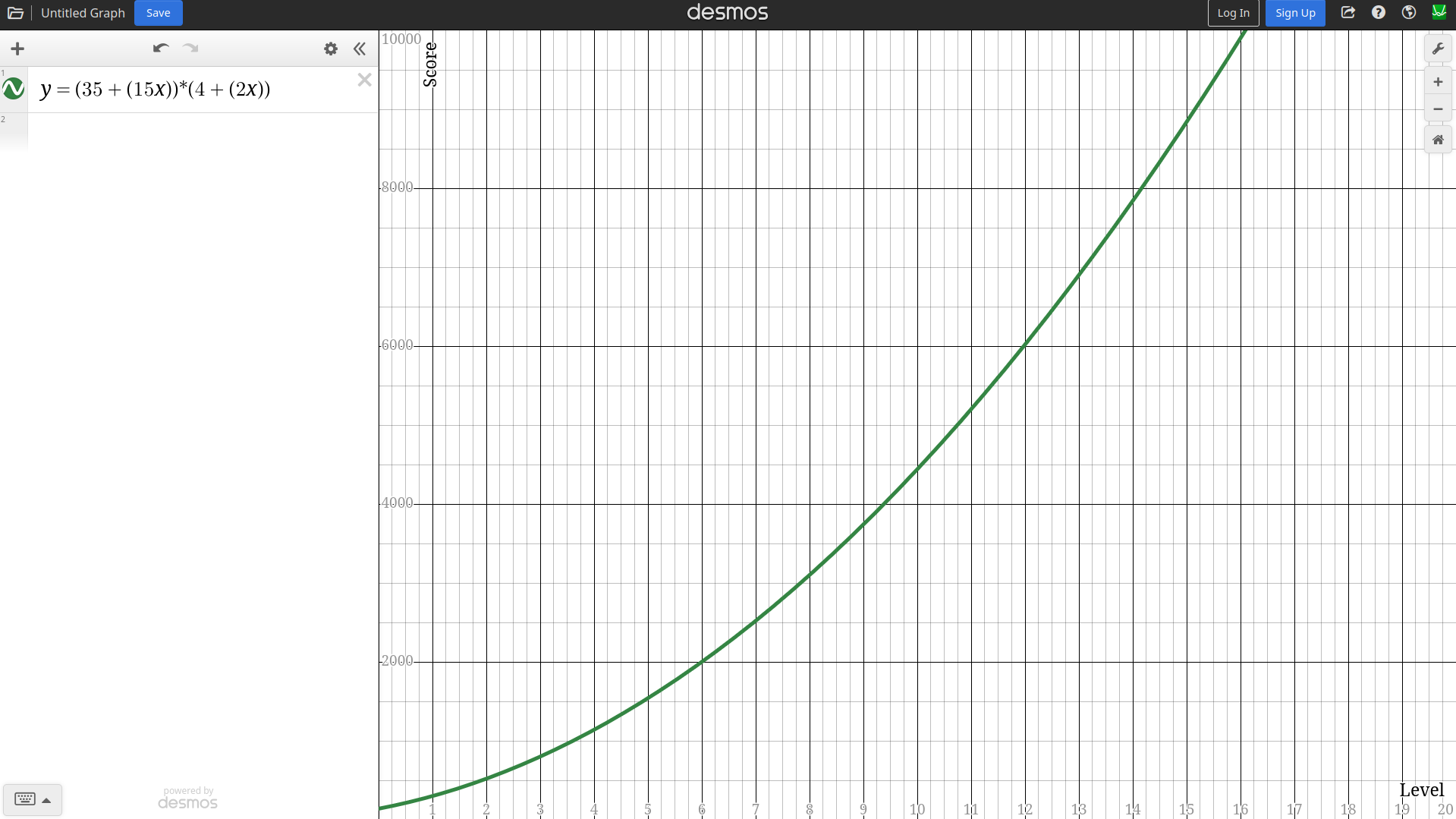
There’s not really a lesson or a “tip/trick” to this, but if you enjoy math you can plot a lot of hand scores to compare them.
Favorite Strategies
Here’s a quick list of some of my favorite things:
Supernova / Spare Trousers + Squircle Joker (Supernova is my favorite Joker, because I highly value it’s slow reliable scaling. This combination is all reliable scaling)
Bull + Boostraps (The Boglehead is another source of reliable scaling of chips and mult, but it requires you to be careful with your spending)
Midas Mask + Vampire (Part 1 Jojo Special offers reliable scaling for xmult, which is hard to come by but very strong. Extra good with Pareidolia)
Planet cards in general (I’m always playing one hand type starting as early as I can, so leveling that hand type and Supernova are my favs - The Flint messes me up)
Ghost Deck (Spectral cards are fun, and early poly on scaling jokers goes hard)
Lucky Cat (Just Lucky Cat. Good thing happens 🢂 Gooder thing happens. Gambling brain go cha-ching. Obviously good with Oops! and any cards that re-trigger cards like Sock and Buskin)
6x Stencil (This is a meme but it happened to me once and it felt so good)
Ancient Joker (If your deck has an even number of each suit and you have a decent level of flushes, this card can win a ton of rounds with just one hand)
Madness + Eternal Cards (If I see Madness early, I almost always snatch it up. As long as you get some halfway decent eternal cards, it’s a free win. Be wary of the “all cards disabled until one card sold” showdown boss blind - but often you can win through it if you got Madness early enough because its scaling is insane)
My favorite deck is Ghost Deck. It lets you create some of the most wacky game situations, such as:
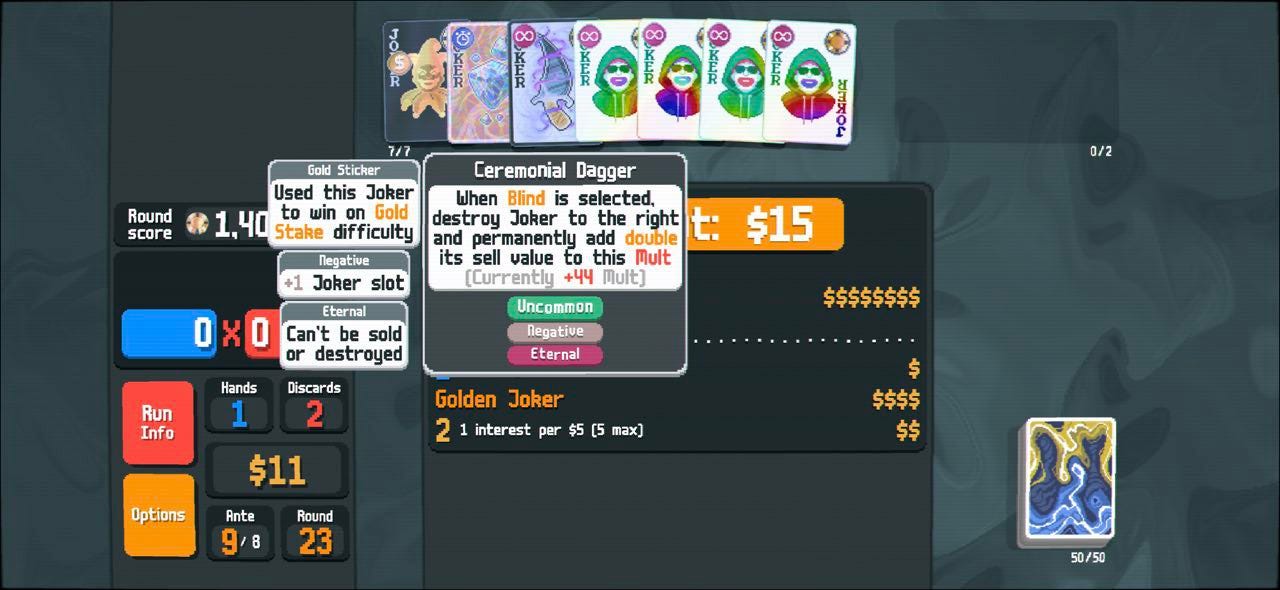
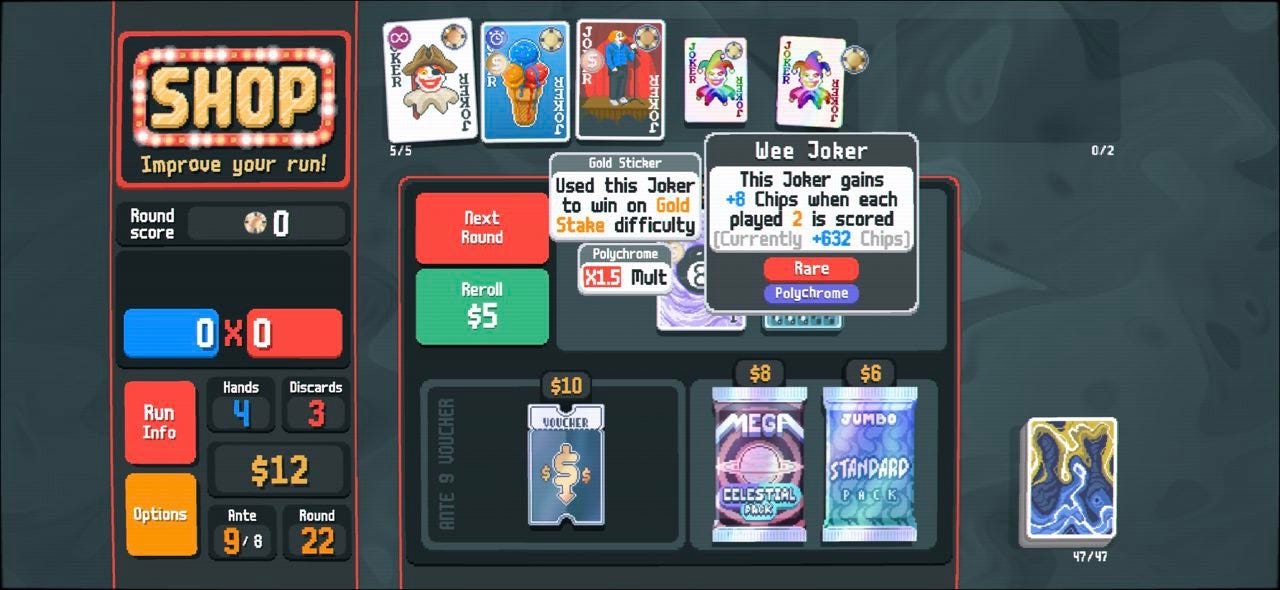
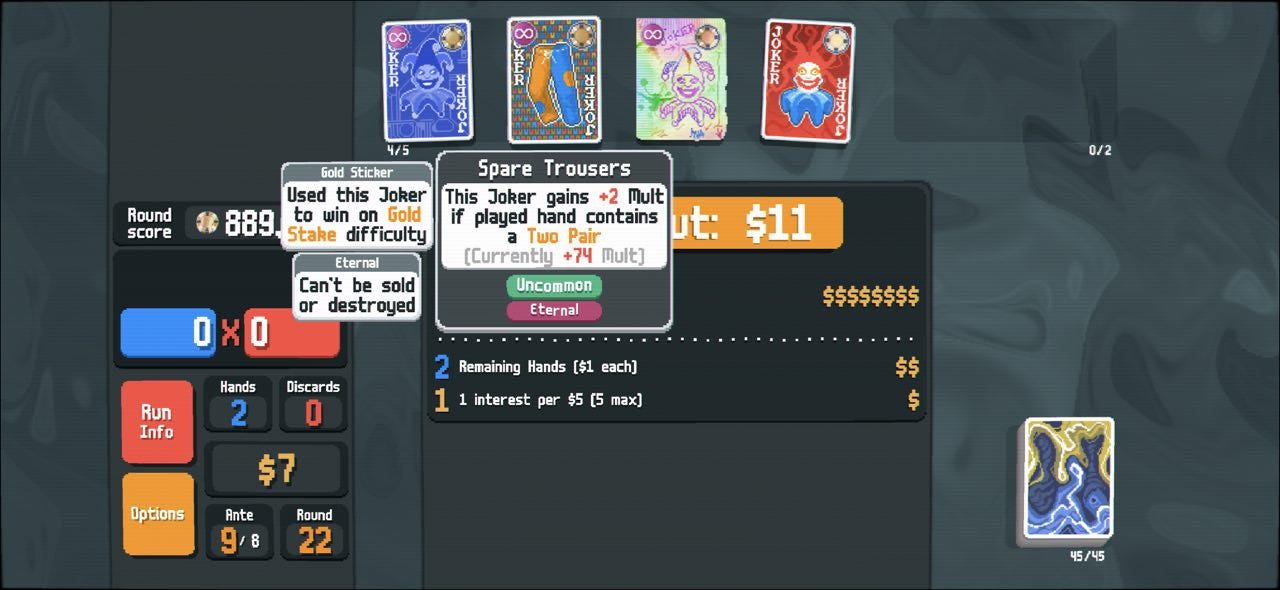
Since the game provides stats for how you’ve played, here are some images of my stat pages. These pages are from before I started working on c++, since that’s more representative of which items I collected willingly.
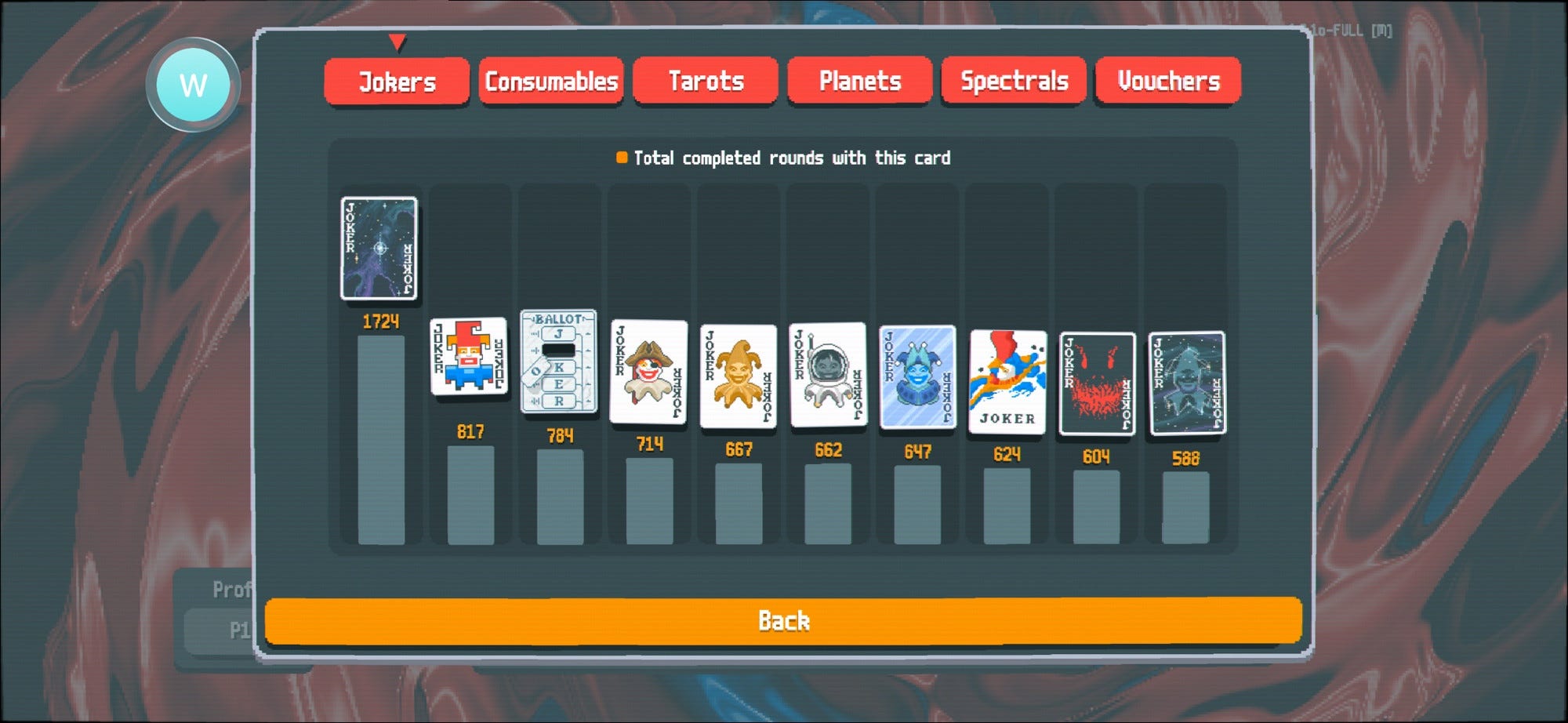
Supernova is, far and away, my most played joker. It’s my GOAT. Usually I’ve figured out which hand I’m going to play that run by the end of ante 2, if not earlier… and usually I spam that hand like no tomorrow.
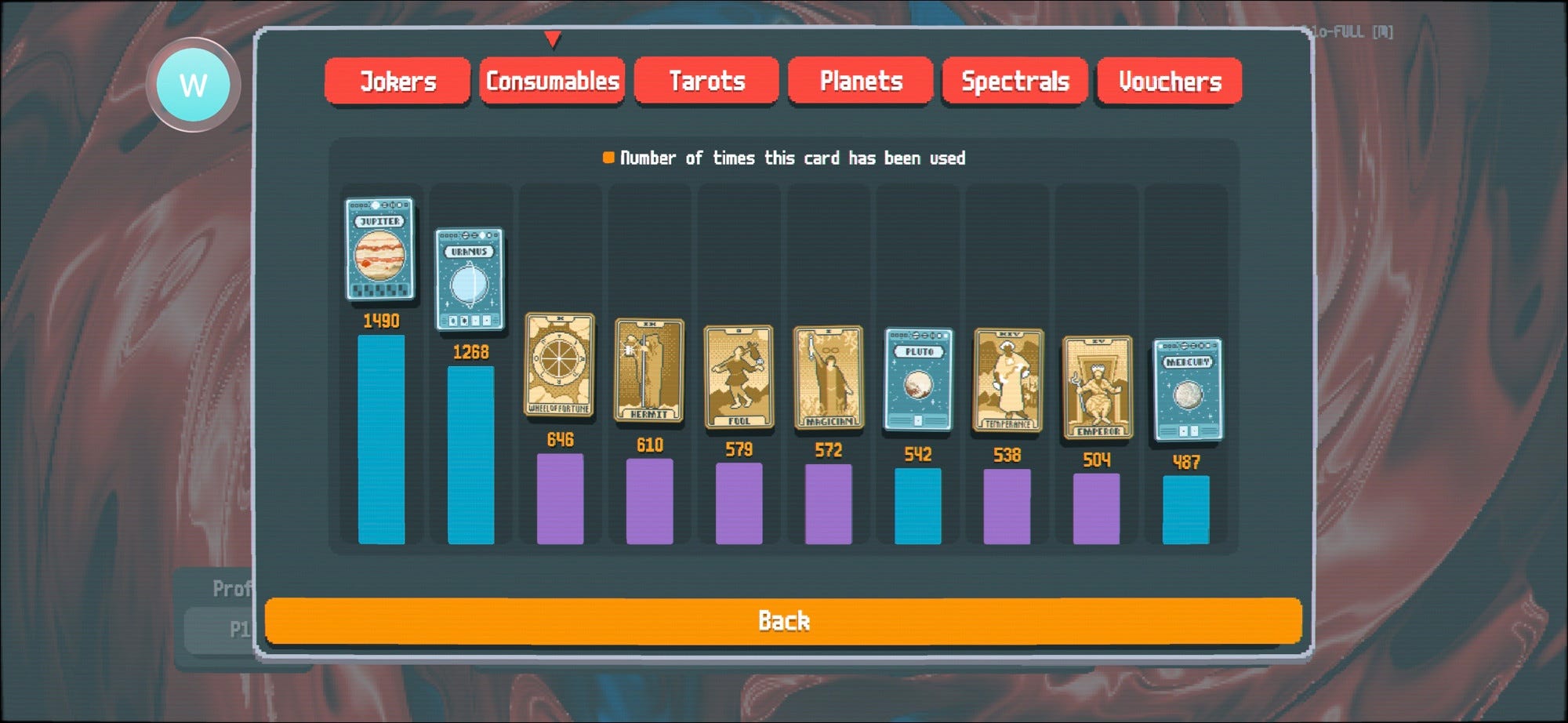
Jupiter (which levels up flushes) and Uranus (which levels up two pair) are my most played planets… and my most played hands. They’re the easiest to fix for and play (as a note, I played a lot of pair during the C++ grind and Mercury shot up to just under Uranus in the post C++ stats). I’m sure that checkered deck boosts Jupiter’s numbers a tad, but honestly I’m nor surprised it’s there because I tend to spam it on other decks too. As for tarots, economy and lucky cards are pretty high up on my list. The only reason Wheel of Fortune is that high is because it’s a good “catch all:” If your economy is already good, you don’t need hermit. The tarots that change the suits of cards are only good if you need that suit. But wheel can safely be picked and stand to benefit you in almost any scenario.
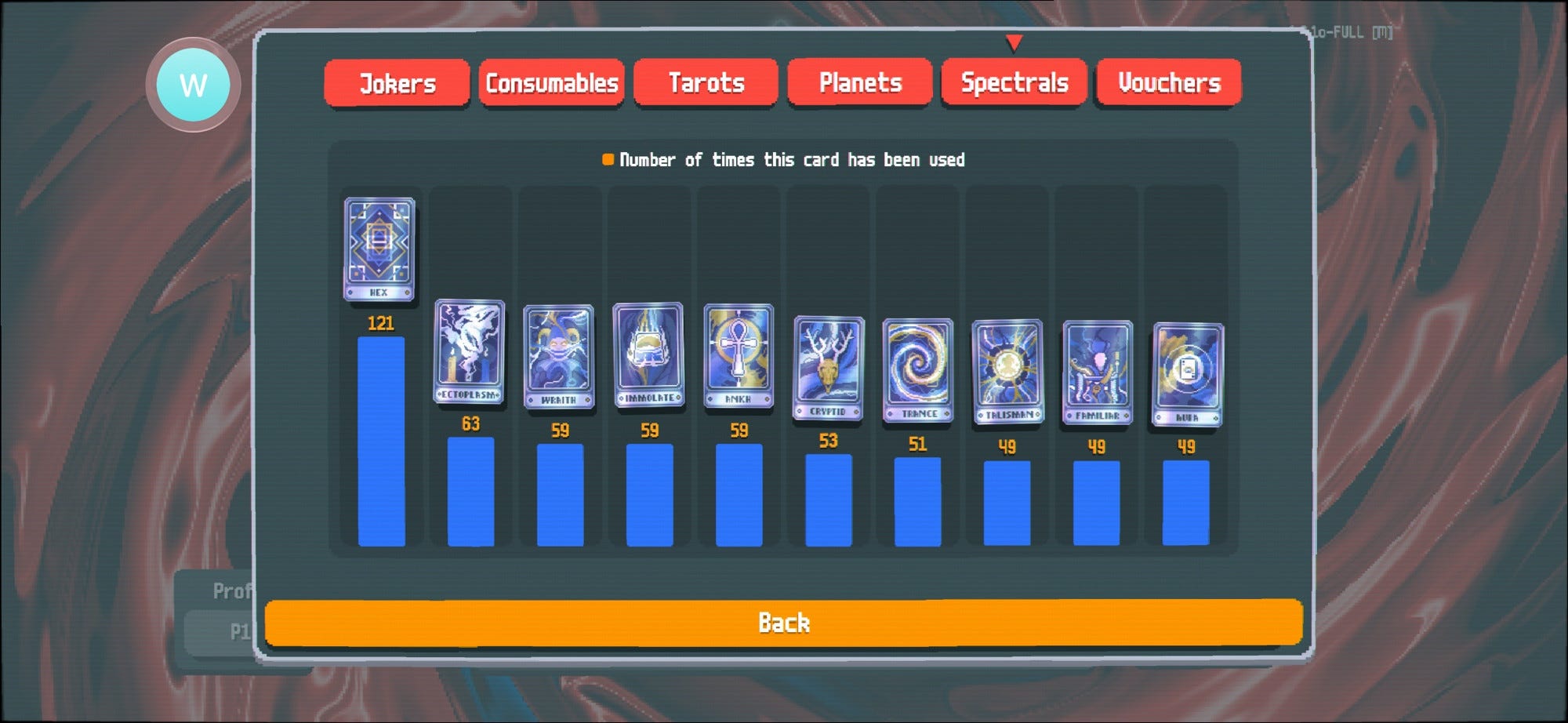
Hex, which also has it’s numbers boosted by being given to you for free in the Ghost Deck, is a solid Spectral that I picked up a lot. An extra 1.5x mult is just good. The next most purchased spectral is Ectoplasm (which turns jokers into a negative joker, effectively giving you greater max hand size for jokers). Honestly I think the negative mechanic is one of the strongest in the game, because it lets you just have an extra joker for free, and I love taking negative skips too.
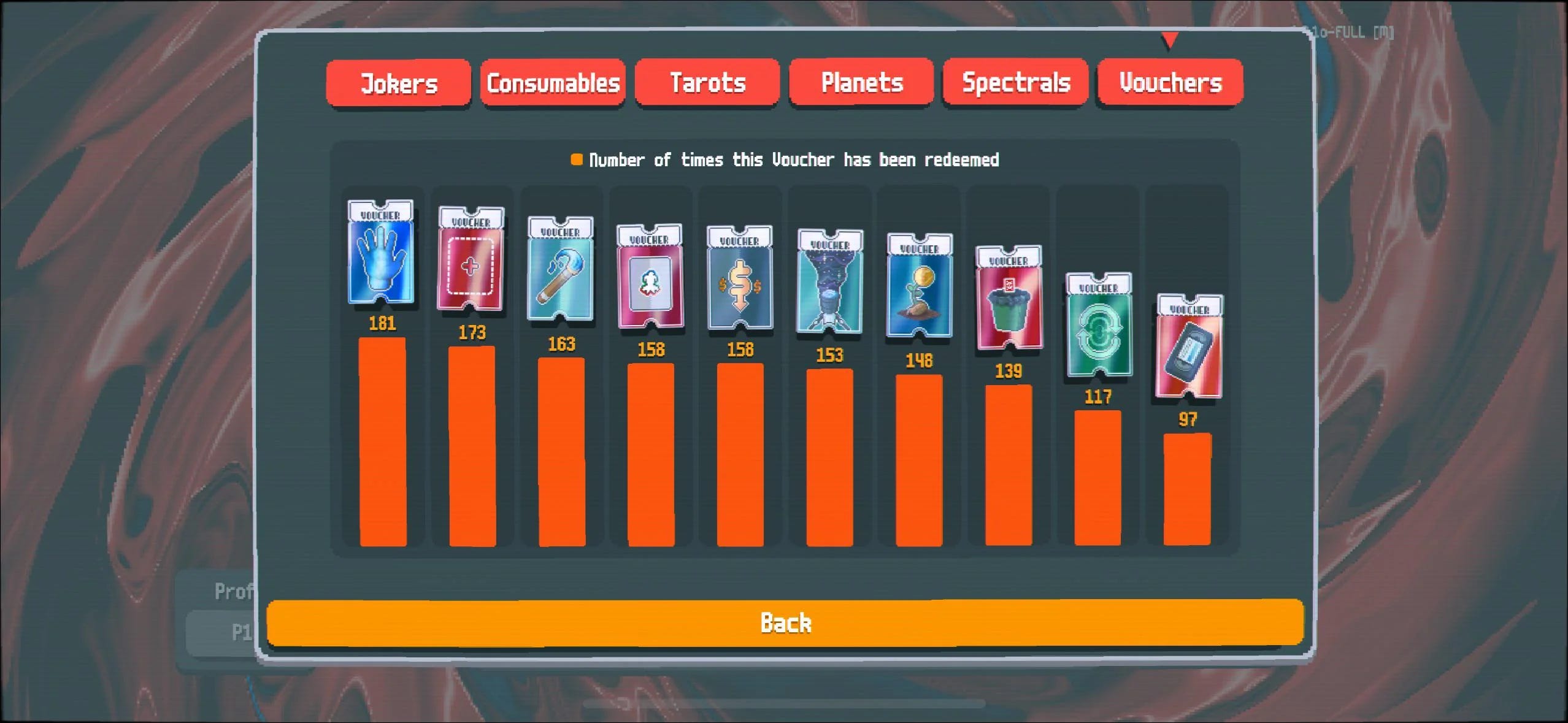
The only surprise here for me is that telescope is so low. I pick up telescope almost every time. Since I’m so proactive about picking which hand I’m going to play and playing it often, Telescope almost always propels my hand level to the moon.
Least Favorite Strategies
I think the game is pretty fun overall, but here’s some things I didn’t really use or like using.
I really never got into playing straights. Obviously I used them on some runs, but they take more effort to fix your deck for than most hands, especially if you want to play more than one straight in a round.
Obelisk is divisive on the Balatro subreddit. I hate it. I’ve won runs with it before, it’s not unusable… but it’s a real pain to use. The run where I got my gold sticker on it, I didn’t even use it.
I generally dislike using jokers and cards that require you to forgo using a resource. For example, cards like Green Joker and Ramen punish you for using discards.
Glass Cards. The way I see it, a card is either a card I want to play, or a card I want to get rid of. I don’t like playing cards I want to get rid of and hoping that they shatter, or accidentally shattering cards I want to play. I use Glass cards exceptionally sparingly, usually near the end of the run I’ll pick up the tarot just in case it saves the last round… or if I’m playing something like Splash where I don’t have to make the card I’m getting rid of part of my real hand to get the Glass effect..
Skip Tags. It took me a long time to realize skipping was an option and that tags existed at all… but even after realizing it, I don’t use them that much. Usually it feels like it’s better to have another round to earn interest, to scale Supernova, to get gold from Gold Joker, etc. The only tags I even consider usually are Negative (negative jokers are so solid) and Investment ($25 is $25, bro). Occasionally I’ll pick up an early Polychrome tag, but not late in the run.
Conclusion
Balatro is a fun game that scratches at least some similar itches as MTG. If you are subscribed to my substack because you like playing EDH, there’s a good chance you’ll enjoy Balatro too. It doesn’t have all the glorious social interaction of a multiplayer game, but when you play it on mobile it can be really addictive to pick up for a few hands at random times during the day.
10/10, all my friends died. 10/10.